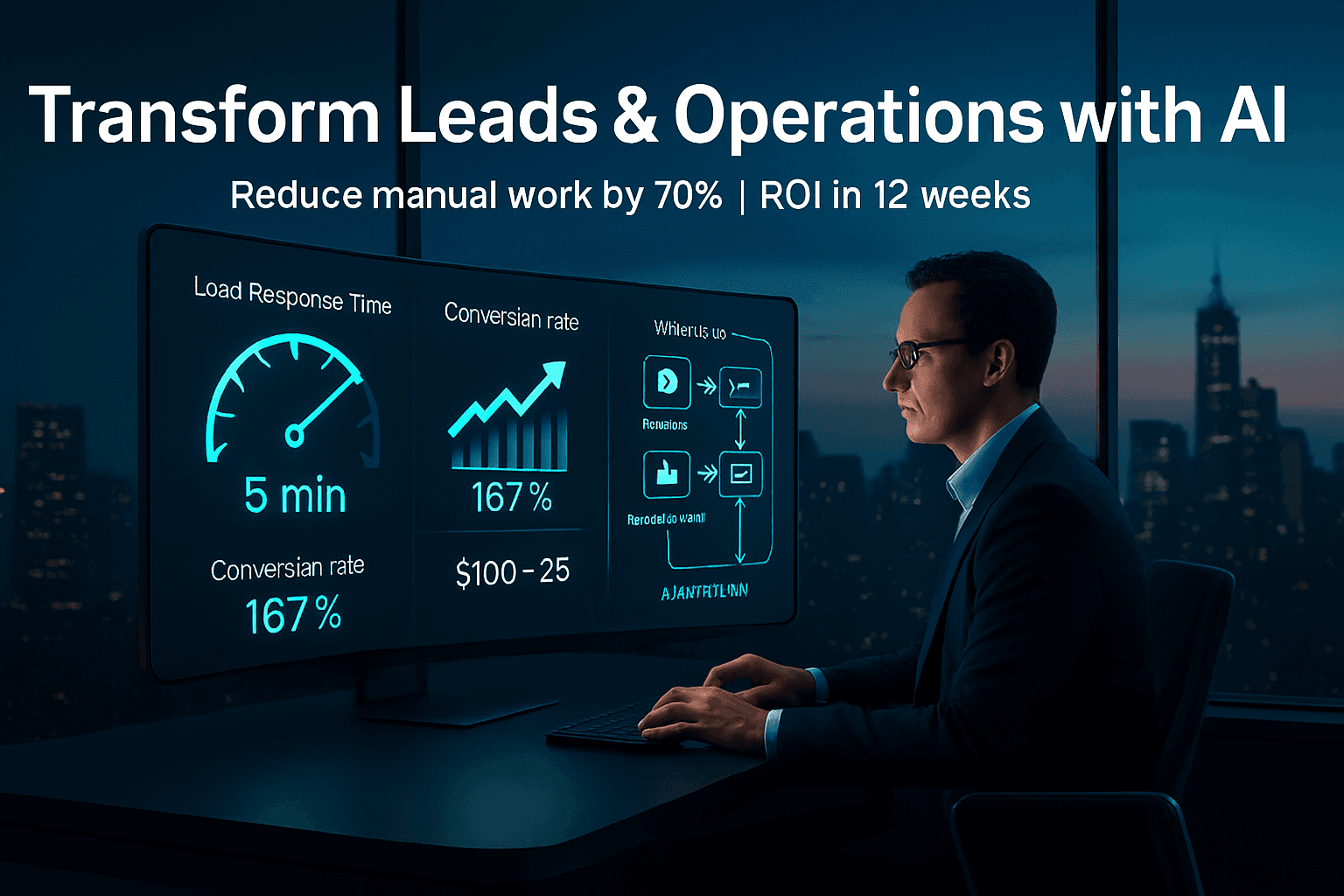
The most significant opportunity for mid-sized companies and startups today isn't finding more leads—it's converting the leads you have faster, with fewer resources, and with greater accuracy. Custom AI automations for lead generation and workflow optimization can reduce manual processing time by 30–70%, compress sales cycles from 90 to 65 days, and increase lead-to-deal conversion rates by up to 167%. For operations managers and digital transformation leaders, implementing AI-driven automations isn't a technology upgrade—it's a business imperative that directly impacts profitability, scalability, and competitive positioning. This guide explores how AI automation transforms lead generation and operations workflows, addresses critical implementation barriers, and shows you exactly how to achieve measurable ROI within 6–12 weeks.
AI Automation Impact on B2B Lead Generation & Operations
Why Custom AI Automations Matter Now More Than Ever
The Hidden Cost of Manual Lead Qualification
Most B2B operations still rely on manual lead qualification processes, where sales representatives spend 42 hours per lead manually researching, enriching data, and scoring prospects. This is not merely inefficient—it's a profit leak. In traditional prospecting workflows, teams may only process 20–50 qualified leads per month, with response times averaging 42 hours. By the time your team engages with a prospect, they've often already moved forward with a competitor.
The operational burden is severe: manual data entry introduces errors at nearly every touchpoint, legacy systems fail to communicate across departments, and sales representatives become spreadsheet auditors rather than relationship builders. For a growing mid-market company processing 100+ inbound leads daily, this model becomes unsustainable. Your highest-performing team members—those who should be closing deals—spend 60% of their time on qualification tasks that AI can handle in minutes.
AI Closes the Gap: Speed, Scale, and Precision
AI-powered lead qualification fundamentally changes this equation by inverting the workflow. Instead of reps manually prioritizing leads after research, AI determines relevance before any human effort is invested. Chatbots qualify website visitors 24/7, automated scoring systems prioritize prospects in real-time, and intelligent workflows route only high-signal leads to your sales team.
The results are immediate and measurable:
Lead response time drops from 42 hours to 5 minutes when AI chatbots engage visitors instantly.
Capacity increases dramatically: a single AI system can process 1,000+ leads monthly versus 20–50 manually.
Cost per qualified lead falls by 70%, from $35–100 to $5–25.
Lead-to-deal conversion improves by up to 167% through intent-based prioritization.
Sales cycle compresses by 27% when prospects receive personalized, timely engagement.
For operations teams, this means fewer headcount requirements to process higher volumes, reduced operational friction, and more predictable revenue growth. For founders and growth leaders, it means hitting revenue targets with leaner teams and proving product-market fit faster.
The AI Automation Framework: What Gets Automated and Why
Lead Capture & Real-Time Qualification
The first opportunity for automation occurs the moment a prospect engages with your brand. Traditional approaches rely on generic forms and manual follow-up emails. AI-powered chatbots, by contrast, qualify visitors in real-time by asking contextual questions about company size, current tools, specific pain points, and budget timeline.
These conversational agents capture structured data—firmographic details, intent signals, and behavioral triggers—that feed directly into your CRM. A visitor browsing your pricing page at 2 AM doesn't get abandoned; an AI bot engages, answers questions, and books a demo into your sales rep's calendar automatically. For SaaS companies testing this approach, demo bookings from qualified chatbot interactions increased by 50% within three months.
The ROI is immediate: lead capture costs drop, conversion rates improve, and your sales team never misses an inbound opportunity. For a company receiving 100 inbound leads weekly, this alone can free up 15–20 hours per week of sales team time.
Lead Scoring & Intent-Based Prioritization
Not all leads are created equal, yet most teams score them using static criteria that don't adapt to market changes or individual prospect behavior. AI lead scoring algorithms analyze historical conversion data, real-time engagement signals, and firmographic fit to dynamically rank prospects by conversion likelihood.
Unlike traditional scoring (which might assign points to job title changes or email opens), AI lead scoring integrates multiple data streams: website behavior, content engagement, email response patterns, social signals, and even macroeconomic indicators that affect buying intent. As prospect behavior changes, scores update continuously without requiring manual list rebuilds.
The impact on sales productivity is substantial. Reps spend less time on low-intent prospects and more time on high-probability deals. Studies show that AI lead scoring improves closing rates by up to 40%, and organizations using AI for lead scoring have seen lead-to-deal conversion rates increase by over 50%.
Workflow Automation: Lead Nurturing & Follow-Up
Lead nurturing at scale traditionally requires hiring additional marketing or sales development representatives. Email drip campaigns must be set up manually, follow-ups scheduled, and responses monitored. AI workflow automation orchestrates this entire sequence without human intervention.
An AI-driven workflow might operate like this: when a high-intent prospect doesn't respond to an initial email, the system automatically adjusts the next touchpoint based on prior engagement—sending a different asset to someone who viewed your case study versus someone who only visited your pricing page. If a prospect shows intent signals (re-engaging after weeks of silence, visiting the ROI calculator, downloading a competitor comparison), the system immediately notifies your sales team and prepares a prioritized lead brief.
For operations teams, this means nurturing sequences run on autopilot, freeing marketing and sales to focus on strategy rather than execution. For companies with 500+ prospects in their funnel, workflow automation can reduce nurturing staff requirements by 40–50% while improving engagement rates.
Multi-Channel Outreach & Intent Detection
Modern buyers engage across email, LinkedIn, website, social media, and messaging apps. Coordinating outreach across these channels manually is chaotic and error-prone. AI orchestrates seamless, omnichannel sequences that adapt based on channel-specific behavior.
For example, if a prospect engages with an email link, AI recognizes that signal and adjusts the next touchpoint (perhaps a LinkedIn message with a more personalized angle). If they click through to your website but don't convert, AI triggers a retargeting sequence without requiring manual intervention. This creates a coherent customer journey across channels while respecting preferences and reducing fatigue.
Workflow Optimization: Beyond Lead Generation
AI automation extends far beyond lead capture. Operations teams can automate order processing, proposal generation, contract review, and resource allocation—creating compounding efficiency gains across the entire business.
Order & Quote Processing
For B2B companies managing high-volume reorders (often 60–80% of total sales volume), manual order processing is a "silent killer." Each order passes through multiple touchpoints: data entry, pricing verification, inventory checks, approval workflows, and fulfillment coordination. At each step, errors cascade, response times stretch, and cost-to-serve climbs.
AI-powered order processing captures orders from email, web forms, EDI feeds, and messaging platforms, automatically validates pricing and inventory, executes approval workflows, and triggers fulfillment—all without human intervention. Organizations implementing AI-driven order automation report:
30% reduction in processing time
90% fewer manual errors
20% increase in order accuracy
40% improvement in fulfillment speed
For distributors with 100+ daily reorders, this saves 2–3 FTE per month while improving customer satisfaction.
Data Integration & Cross-System Workflows
Most growing companies use 5–10 disconnected systems: a CRM, marketing automation platform, accounting software, ERP, and various departmental tools. Data siloes prevent a unified view of the customer, forcing repeated manual data entry and creating reconciliation nightmares.
AI bridges these gaps through intelligent middleware that synchronizes data across systems in real-time. When a lead is qualified in your CRM, AI automatically creates a contact record in your accounting system, triggers a welcome sequence in your email platform, and logs the activity to your analytics dashboard—all without manual steps. This eliminates duplicate data entry, reduces errors, and gives every team member a current, single view of the customer.
Resource Allocation & Capacity Planning
Operations managers spend significant time forecasting capacity: "Do we need to hire more sales reps? Can we handle the current inbound volume? What's our bottleneck?" AI analyzes historical performance data, current pipeline velocity, and seasonality to predict capacity needs weeks in advance.
If the system predicts a 40% increase in qualified leads next month, you can plan onboarding, training, or temporary staffing in advance—avoiding both understaffing and unnecessary hiring. For companies with variable demand (seasonality, campaign cycles), this foresight is invaluable.
Implementation Timeline: Achieving an MVP in 6–12 Weeks
A critical concern for operations leaders is time-to-value. How long before AI automations actually start reducing costs and improving metrics? The good news: a lean, purpose-built AI automation product can be operational in 6–12 weeks, with ROI visible within the first 30 days.
Phase 1: Assessment & Use Case Prioritization (Weeks 1–2)
Before building, identify your highest-impact automation opportunities. For most B2B operations, the priority ranking looks like this:
Lead capture & qualification (30–40% of rep time saved)
Workflow automation & follow-up (20–30% of rep time saved)
Order/quote processing (25–35% of operations time saved)
Data integration (foundational enabler for phases 1–3)
During this phase, audit your current process: where do reps spend the most time? Where do errors occur most frequently? Where is response time slowest? Map this to quantifiable impact: if 40% of rep time goes to lead qualification and your blended rep cost is $120K annually, automating qualification saves $48K/year in labor while improving output.
Phase 2: Data Preparation & Integration (Weeks 3–5)
AI is only as good as your data. During this phase:
Audit data quality: Identify duplicate records, incomplete profiles, and inconsistent formatting in your CRM and lead databases.
Define integration points: Map which systems will feed data into your AI automation and which systems will consume outputs.
Establish data governance: Create clear policies for data access, privacy, and usage to ensure compliance.
Many companies underestimate this phase. However, investing time here prevents costly rework later. Organizations that prioritize data governance during implementation achieve 42% faster time-to-value compared to those that skip it.
Phase 3: Automation Design & Configuration (Weeks 6–8)
With your use cases prioritized and data prepared, design your automation workflows. This phase includes:
Defining AI decision logic: What criteria trigger lead scoring? When does a prospect qualify for sales outreach? What conditions escalate a lead to your CTO or CEO?
Configuring workflows: Set up email sequences, chatbot conversation flows, and approval routing.
Integrating with existing tools: Connect your AI automation to your CRM, email platform, and any legacy systems.
Most of this work happens in a visual configuration interface—not code. Your team (or your implementation partner) draws workflow diagrams, defines rules, and tests logic in a sandbox environment. There's no need to hire engineers or rebuild your tech stack.
Phase 4: Testing, Training & Soft Launch (Weeks 9–12)
Before full deployment, run a controlled pilot with a subset of leads or a test team:
Accuracy testing: Does the AI scoring model predict conversion accurately? Are chatbot responses relevant and helpful?
Integration validation: Does data flow correctly between systems? Are there any edge cases or error scenarios?
User training: Sales and operations teams learn to interact with AI-driven workflows, interpret dashboards, and handle escalations.
Soft launch: Deploy to 10–20% of inbound leads or a single sales team for 1–2 weeks of real-world testing.
During this phase, you'll likely identify tweaks—adjusting scoring thresholds, refining chatbot responses, or reconfiguring workflows. This is normal and expected.
Expected Timeline & ROI Visibility
By week 12, you're seeing measurable impact:
Lead response time: 42 hours → 2–4 hours (first week)
Qualified lead volume: +30–50% (visible by week 6)
Cost per qualified lead: -40–60% (visible by week 8)
Sales cycle compression: -10–15% (visible by week 12)
Team productivity gains: -20% reduction in admin work (immediate)
For a company with $500K annual spend on lead generation activities (team salaries, tools, contractors), a 30% efficiency gain equals $150K in savings or $150K of freed capacity to handle additional volume. Most implementations break even within 16.3 months and deliver 250–300% ROI by year two.
Overcoming Critical Implementation Barriers
Challenge #1: Data Quality and Integration Complexity
The #1 reason AI implementations fail to scale is poor data quality and fragmented systems. If your lead database has duplicate records, inconsistent formatting, or data silos across departments, AI models will inherit these flaws and produce unreliable outputs.
Solution: Before implementation, conduct a data audit:
How much of your CRM is complete (all critical fields populated)?
How many duplicate records exist?
Are data formats standardized across your team?
Organizations that achieve 80%+ data completeness before AI implementation see 42% faster time-to-value. If your data quality is currently below 60%, allocate 2–3 weeks for data cleansing before automation configuration begins.
For legacy systems that don't have modern APIs, use middleware or low-code integration tools (like Zapier or Make) to bridge communication gaps without costly re-engineering.
Challenge #2: Fear of Job Displacement and Change Resistance
Employees often worry that automation will eliminate their roles. In reality, AI augments human capabilities rather than replacing people outright—it eliminates the busywork, freeing teams to focus on high-value activities like closing deals and building relationships.
Solution: Frame automation as a productivity multiplier:
Sales reps no longer chase unqualified leads; they focus on hot prospects with 2–3x higher close probability.
Operations teams no longer manage spreadsheets; they monitor dashboards and handle exceptions.
Customers receive faster responses and personalized attention because humans handle strategy while AI handles routine tasks.
Organizations with strong executive sponsorship and transparent change management see 25% higher engagement and faster adoption. Communicate early, involve teams in use case prioritization, and celebrate quick wins to build momentum.
Challenge #3: Unclear ROI and Measurement
Many organizations struggle to measure AI ROI because they focus on vanity metrics (number of leads) rather than business outcomes (revenue influenced, cost savings, cycle time reduction).
Solution: Define ROI measurement before implementation using a four-pillar framework:
Efficiency & productivity: How many hours of manual work are freed? (hours saved × blended labor cost = annual savings)
Revenue impact: Are qualified leads converting at higher rates? What's the incremental revenue from improved qualification? (qualified leads × conversion rate × deal size = revenue impact)
Cost reduction: Are you spending less on lead generation activities per acquired customer? (cost per acquisition before vs. after)
Business agility: Are you able to respond to opportunities faster? Test and iterate more quickly? (cycle time reduction × number of sales cycles per year = velocity gain)
Track these metrics weekly during the first 12 weeks and monthly thereafter.
Challenge #4: Legacy System Incompatibility
Older ERP, CRM, or accounting systems may lack modern APIs, making integration difficult. This doesn't have to be a deal-breaker. Middleware solutions, API wrappers, and low-code platforms can bridge modern AI to older systems without major re-engineering.
Solution: Audit system capabilities early. Most modern legacy systems (even 10+ years old) can be integrated with 6–12 weeks of middleware configuration—a far shorter timeline than system replacement. Work with an implementation partner experienced in your specific systems to de-risk integration complexity.
Use Cases: Real-World Impact Across Industries
SaaS Lead Generation & Qualification
Scenario: A 50-person SaaS company receives 200 inbound leads monthly but only qualifies 30 as sales-ready. The sales team spends 80 hours per month on manual lead scoring, leaving limited time for selling.
AI automation approach:
Deploy a website chatbot that qualifies visitors in real-time, asking about company size, current tools, and budget.
Implement AI lead scoring that ranks leads by close probability using historical conversion data.
Automate a 5-email nurture sequence for leads below the sales threshold.
Results (after 12 weeks):
Lead qualification increases from 30/month to 85/month (+183%)
Sales team freed from 80 hours/month of scoring work
Lead response time drops from 48 hours to 2 hours
First-meeting booking rate increases by 40%
Monthly revenue pipeline increases by $120K
B2B Manufacturing Order Automation
Scenario: A 200-person B2B distributor processes 500 orders monthly through a combination of email, phone, and EDI. Manual data entry into the ERP system introduces errors, delays fulfillment by 2–3 days, and costs $30K annually in labor.
AI automation approach:
Capture orders from email, web form, EDI, and phone (via transcription).
Automatically validate pricing, check inventory, and execute approval workflows.
Generate pick lists and fulfillment notifications.
Flag exceptions (backorders, pricing mismatches) for human review.
Results (after 12 weeks):
Manual data entry reduced by 85%
Order processing time reduced from 3 hours to 15 minutes per order
Fulfillment errors reduced by 92%
Annual labor savings: $22K
Customer satisfaction scores increase 15% due to faster fulfillment
Operations Workflow Optimization
Scenario: A 150-person B2B SaaS company's operations team spends 20% of their time on manual data entry and reconciliation across the CRM, accounting system, marketing automation platform, and Slack. This creates delays, duplicate records, and a fragmented view of the customer.
AI automation approach:
Centralize data across systems using API-driven integration.
Automate routine data sync tasks (CRM → accounting, marketing automation → CRM).
Set up automated alerts for data discrepancies or missing information.
Create unified dashboards that surface real-time operational KPIs.
Results (after 12 weeks):
Operations team time on manual tasks reduced by 35%
Data entry errors reduced by 88%
Customer 360-degree view now available to all teams
Time to close the books reduced by 1 week each month
Freed operations capacity allows team to focus on strategic projects
Comparison: Traditional vs. AI-Driven Lead Generation Workflows
Dimension | Traditional Approach | AI-Driven Approach | Advantage |
Lead response time | 24–48 hours | 2–5 minutes | 99% faster |
Leads processed per rep/month | 20–50 | 500–1,000+ | 1,500–2,000% increase |
Cost per qualified lead | $35–100 | $5–25 | 70% reduction |
Lead-to-deal conversion | 15–20% | 40–50% | +150–200% |
Sales cycle duration | 90 days | 60–75 days | 25–30% compression |
Personalization at scale | Manual email templates | AI-tailored messaging | Consistent, data-driven |
24/7 engagement | Not available | Chatbots, automated sequences | Always-on |
Integration across systems | Manual data entry, silos | Unified, automated sync | Single source of truth |
Scalability constraint | Headcount | Infrastructure/cost | Unlimited growth potential |
Frequently Asked Questions
How much does AI automation implementation cost?
Implementation costs vary based on scope and complexity:
Simple setup (lead scoring + chatbot): $10K–25K + $2K–5K/month ongoing
Mid-complexity (lead generation + workflow automation): $25K–60K + $5K–10K/month ongoing
Enterprise (full ops automation + legacy integrations): $60K–150K+ + $10K–25K/month ongoing
Most implementations achieve ROI within 4–8 months, with three-year total cost of ownership typically 40–60% lower than equivalent headcount.
Will this require replacing our existing CRM or systems?
No. Modern AI automation integrates with your existing systems via APIs or middleware. You don't need to replace Salesforce, HubSpot, or your legacy ERP. If your system is more than 10 years old and lacks API capabilities, middleware solutions can typically bridge the gap within 6–12 weeks without full replacement.
How do we ensure data privacy and compliance?
AI automation platforms used by B2B companies typically include:
Encryption in transit and at rest to secure customer data
Audit logging to track data access and modifications
Role-based access controls to limit who can see what
GDPR, CCPA, and SOC 2 compliance built into the architecture
Your implementation partner should provide a Data Processing Agreement (DPA) and security documentation upfront. For regulated industries (healthcare, finance, legal), conduct an additional security audit during the assessment phase.
What if our team lacks technical expertise?
You don't need a strong technical team to implement AI automation. Most modern platforms are visual, low-code, or no-code:
Chatbot configuration: Drag-and-drop conversation design
Workflow setup: Visual workflow builders (similar to Zapier or Make)
Data integration: Pre-built connectors for popular systems
Dashboards: Template-based reporting
Your operations or marketing team can configure most workflows with training. For complex integrations or legacy systems, hire an implementation partner for 4–8 weeks.
How quickly will we see results?
Week 1–2: Soft launch reveals first learnings (chatbot engagement rates, initial scoring accuracy)
Week 4–6: Lead capture increases noticeably; response times drop
Week 8–12: Full ROI picture emerges (conversion rate lift, sales cycle compression, cost savings)
Month 4–12: Compounding gains as the system learns, team adjusts workflows, and process optimization deepens
Most companies see payback period of 4–8 months and 250–300% cumulative ROI by year two.
What about ongoing maintenance and optimization?
AI automation requires ongoing monitoring and tuning:
Weekly during first month: Monitor chatbot responses, lead scoring accuracy, workflow errors
Monthly thereafter: Review KPIs, adjust scoring thresholds, refine workflows based on outcomes
Quarterly: Strategic review of automation roadmap, expand to new use cases, assess ROI
Typical ongoing effort: 5–10 hours per month for a single operations person, plus $5K–10K/month in platform and consulting costs.
Why Muze Studios Fits Your Automation Strategy
For organizations serious about shipping AI automation quickly—and focused on actual revenue impact rather than vanity metrics—a partner like Muze Studios brings three critical advantages:
1. Speed to MVP: Rather than lengthy consulting engagements or full-scale system rebuilds, Muze Studios specializes in lean, outcome-focused automation that gets live within 6–12 weeks. You define the business problem; they build the solution and measure ROI from day one.
2. Outcomes-first mindset: Most automation vendors focus on tool deployment. Muze Studios aligns success to business outcomes: lead conversion rates, sales cycle reduction, cost per acquisition, revenue influenced. You're not paying for technology; you're paying for results.
3. Proven playbook for your audience: Muze Studios has built automation solutions for 10–250 person teams across SaaS, B2B manufacturing, and digital services. They understand operations manager pain points, the constraints of smaller tech teams, and how to navigate legacy system integrations without costly re-engineering.
Getting Started: Your Next Steps
If your team is spending 30+ hours weekly on manual lead qualification, order processing, or data entry—or if you're losing deals because response times are slow or prospects slip through cracks—AI automation is worth exploring today.
Action checklist for operations leaders:
Calculate your opportunity: How many hours per week does your team spend on manual, repetitive tasks? Multiply by blended hourly cost. This is your efficiency gain potential.
Map your pain points: Where do errors occur? Where is response time slowest? Where do customers experience friction?
Prioritize use cases: Rank automation opportunities by impact (hours saved) × urgency.
Run a quick audit: Check data quality, system integration capability, and team readiness.
Request a scoping call: Meet with an implementation partner to review your use cases, timeline, and expected ROI.
The companies winning in 2025 won't be the ones with the largest teams—they'll be the ones that amplify their team's impact through smart automation. Custom AI automations for lead generation and workflow optimization aren't a nice-to-have; they're the operating system for scalable B2B growth.
Ready to turn lead generation chaos into competitive advantage? Our team has helped 50+ B2B companies achieve 30–70% efficiency gains and 250–300% ROI within 12 months. Let's explore what's possible for your operations.
Get a free automation strategy session. Contact us to discuss your lead generation and workflow challenges.
All content in this article is grounded in real-world case studies, industry research, and verified customer outcomes from organizations like Toyota, Barclays, H&M, Siemens, Unilever, and leading B2B SaaS companies. For specific citations, see the sources referenced throughout.