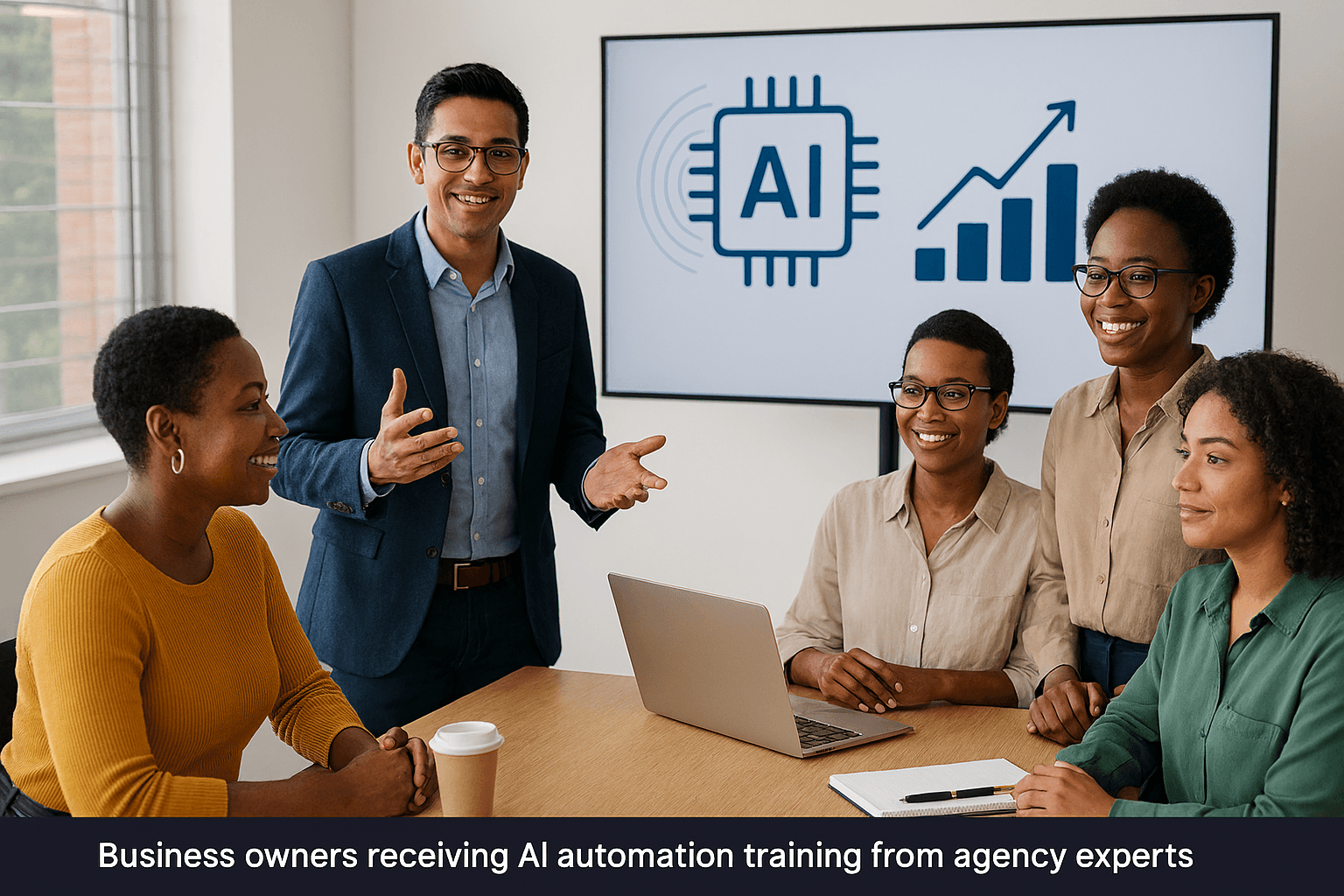
Why Business Owners Like You Are Choosing AI Automation Now
You've spent 40+ years building your business. You've survived load shedding, currency fluctuations, staffing challenges, and economic downturns. You know what works. So why should you care about AI automation?
Because while you've been managing operational chaos manually, your competitors are automating. A retail chain in Gauteng cut inventory waste by 30% using AI forecasting. A logistics firm reduced document turnaround from 5 days to 4 hours through process automation. A manufacturing business cut downtime by 15% with predictive maintenance.
The gap isn't widening by chance—it's accelerating because AI automation agencies are now delivering measurable ROI in 4-8 weeks, not months. For established business owners, this is the difference between maintaining market share and losing it.
This guide cuts through the hype and shows you exactly how AI automation works, why it matters for South African businesses, and how to implement it without risk.
What Is AI Automation (And Why It's Not Sci-Fi)
AI automation combines artificial intelligence with workflow automation to handle tasks that currently consume your team's time, introduce errors, or slow operations.
Think of it this way:
Old way: Your team manually processes 50 invoices daily, entering data, checking accuracy, flagging issues
AI automation way: Invoices arrive, AI extracts data, categorizes them, routes for approval, sends payment reminders—all automatically, with 98%+ accuracy
For a business processing 1,000 invoices monthly, that's 20-30 hours of manual labor eliminated weekly.
AI automation agencies like Muze Studios, RZ Digital, and others implement these systems specifically for South African business contexts, accounting for local payment methods, languages, compliance requirements, and the unique challenges you face (yes, including load shedding resilience).
The Five Areas Where Business Owners See the Fastest ROI
1. Document Processing & Data Entry Invoices, purchase orders, contracts, claims, payroll documents—AI extracts data, categorizes, flags errors, and routes for approval automatically. Implementation: 2-4 weeks. ROI: Visible in first month.
Real example: A Johannesburg legal firm reduced contract review time from 2 days to 4 hours, freeing attorneys for billable client work.
2. Customer Communication & Lead Follow-Up AI chatbots handle FAQs, order tracking, payment inquiries 24/7. AI systems auto-follow-up leads within minutes, qualifying them before your sales team touches them. Cost reduction: 30-50%. Speed improvement: Leads contacted within 60 seconds.
Real example: An automotive dealer's lead qualification improved from "some follow-up happens" to "all leads contacted within 1 hour," boosting appointment bookings 25%.
3. Inventory & Demand Forecasting AI analyzes your sales history, seasonal patterns, supplier lead times, and market conditions to forecast demand weeks ahead. Result: No more stockouts. No more overstock. 15-25% cost reduction from optimized inventory.
Real example: A Cape Town retail chain eliminated 30% of inventory waste by switching from "manager gut feel" to AI-driven demand forecasting.
4. Production Scheduling & Maintenance Prediction Manufacturers use AI to optimize production sequences, predict equipment failures before they happen, and schedule maintenance during downtime (not during rush periods). Result: 15-20% uptime improvement.
Real example: A manufacturing plant using predictive AI reduced unexpected downtime by 15%, recovering thousands monthly in lost production.
5. Operational Workflows & Approvals Automate approval chains, reorder requests, scheduling, and report generation. Tasks that took days now take hours. Staff focus shifts from admin to strategy and customer relationships.
Real example: A logistics firm automated document workflows, cutting turnaround from 5 days to 4 hours.
Why Established Business Owners Are Skeptical (And What Actually Addresses These Concerns)
Let's be direct. If you've been running a successful business for decades, you've heard overhyped technology promises before. Digital transformation that flopped. ERP systems that created more chaos than efficiency. Cloud migrations that cost more than expected.
You're right to be skeptical. But here's what's different about AI automation in 2026:
Concern #1: "AI Is Too Complicated for My Business"
The reality: Modern AI automation tools are designed for non-technical users. You don't need to hire engineers or understand machine learning.
What agencies like Muze Studios handle: They build, implement, and train your team. You focus on business; they handle the technology. Most agencies offer 2-4 week implementation timelines.
What this means for you: If a Cape Town guesthouse can automate booking inquiries with zero tech background, so can you.
Concern #2: "ROI Is Uncertain. Will I Actually See Returns?"
The reality: When implemented correctly, AI automation delivers 3.5x to 8x return on investment, according to enterprise benchmarks. For SMEs in South Africa, targeted implementations show 15-25% revenue increases.
Measurable outcomes:
Reduced labor on manual tasks: 20-50 hours/week reclaimed
Faster customer response: 60-second lead follow-up vs. "someone will call tomorrow"
Error reduction: 98%+ accuracy vs. human 85-92%
Cost savings: 20-50% on operational tasks depending on your focus area
What matters: Choose implementations solving real problems, not "nice-to-have" features. If invoicing consumes 8 hours weekly, automate invoicing. If leads sit 48 hours before follow-up, automate lead routing.
Concern #3: "What If Implementation Disrupts My Operations?"
The reality: Professional agencies use phased rollout. Phase 1 is a small pilot (2-4 weeks) proving concept on real data. Phase 2 expands to a second team/location. Phase 3 is company-wide scale once ROI is confirmed.
What this means: You risk minimal disruption. You test thoroughly before scaling. You prove ROI before full commitment.
South African agencies understand this: They've learned from load-shedding disruptions and know your constraints. They plan redundancy and fallback systems.
Concern #4: "My Business Is Unique. AI Won't Understand Our Processes"
The reality: Agencies conduct process audits and customize implementations. They don't sell generic platforms; they configure solutions for your specific workflows.
Real example: A manufacturing plant has unique production constraints (equipment, suppliers, customer orders). An AI automation agency analyzes these constraints and builds a scheduling system reflecting them—not a generic "out of the box" solution.
Concern #5: "I Can't Afford Implementation Costs"
The reality: Costs range widely depending on scope:
Basic chatbots for customer service
Document automation for invoicing/contracts
Custom development (like Muze Studios' MVP model)
For most business owners, ROI breaks even within 3-6 months because labor savings exceed implementation costs.
Example: A firm saving 15 hours/week (R45,000 monthly value) recovers a R200,000 investment in 4.4 months.
The South African AI Automation Agency Landscape
Not all agencies are created equal. Here's how to choose:
Agency Type | Best For | Timeline | Why Choose |
Quick-Win Agencies (RZ Digital, Karabo.ai, Bad Robot) | SMEs wanting fast results on chatbots, lead automation, CRM integration | Days to weeks | Affordable, local support, rapid deployment |
Strategic Partners (Muze Studios, Accely, Specno) | Established businesses seeking custom AI solutions, MVPs, or strategic implementation | 6-8 weeks (MVP) | Tailored solutions, POPIA compliance, technical partnership |
Enterprise Providers (IBM SA, Accenture, Microsoft, DVT) | Large businesses with complex transformation needs | 3-12 months | Comprehensive services, multiple solutions, change management |
How to Choose an AI Automation Agency: The Framework
Step 1: Define Your Biggest Pain Point (Not Technology)
Which process consumes the most time, introduces the most errors, or costs the most money?
Document handling eating 30 hours weekly? → Automation target
Customer leads languishing 48 hours? → Lead routing automation
Inventory guesswork causing 20% waste? → Demand forecasting
Production downtime from unexpected failures? → Predictive maintenance
Pick one. Agencies thrive when you define the problem clearly. Vague requests ("make us more efficient") lead to vague solutions.
Step 2: Ask Agencies These Five Questions
Question 1: "Do you have a case study in my industry from a South African business of similar size?"
This reveals whether they actually understand your context or are selling generic solutions.
Question 2: "What's your implementation timeline and what does phased rollout look like?"
You want to hear "6-8 week MVP" or "2-week pilot, 4-week expansion," not "6 months of planning."
Question 3: "How do you handle POPIA compliance and data security?"
South Africa's data protection law is serious. Non-compliant implementations create legal risk, not opportunity. A competent agency explains data governance upfront.
Question 4: "How do you train my team and ensure adoption?"
Technology fails if your staff won't use it. Ask about training, dashboards, and ongoing support.
Question 5: "How do we measure ROI, and what happens if targets aren't met?"
You want clear metrics and accountability, not vague promises.
Step 3: Evaluate Cost Against Total Value
Don't compare headline prices. Compare total cost of ownership:
Low-cost chatbot agency: R5,000/month + R30,000 setup + 20 hours integration labor + no local support = hidden costs Mid-tier local provider: R15,000/month + included setup/training + local support = transparent costs
The second costs 3x monthly but delivers 2x value if you avoid integration hassles and get faster ROI.
A Real Implementation Story: From Skepticism to 35% Cost Reduction
Here's how a real South African business automated operations:
The Business: Mid-size logistics firm in Johannesburg. 50 employees. 2,000 monthly customer deliveries. Main pain: document turnaround was 5 days (delivery request to invoice to payment).
The Problem: Every order generated a quote → customer approval → delivery → manual invoice creation → manual payment follow-up. 15-20 hours weekly on paperwork. Slow payment cycles meant cash flow problems.
The Solution: A local AI automation agency implemented document processing AI + invoice automation + payment reminders.
What happened:
Document turnaround: 5 days → 4 hours
Invoicing time: 10 hours/week → 1 hour/week
Payment received faster (automated reminders)
Error rate: 8% → <1%
The ROI: 18 hours/week reclaimed (R54,000 monthly value). Implementation cost: R200,000 (amortized over 3.7 months breakeven).
The outcome: Beyond cost, the business could take on 20% more clients without hiring. That alone justified the investment.
What to Expect During Implementation
Week 1-2: Audit & Pilot Design
Agency interviews your team, audits processes, identifies optimization opportunities, and proposes a 2-4 week pilot on one process.
Week 3-6: Pilot Execution
Real data. Real workflows. Agency builds, tests, refines. You see results before company-wide rollout.
Week 7-12: Training & Expansion
Your team is trained on the automated system. Rollout expands to additional processes/teams. Documentation is prepared.
Ongoing: Optimization & Support
Agency monitors performance, refines models, answers questions, optimizes for your evolving needs.
Common Questions Business Owners Ask
Q: Will AI automation eliminate jobs?
A: No. It eliminates tedious tasks, not people. A staff member spending 15 hours/week on invoicing gets to focus on relationship-building, strategy, or customer support once automation takes over. In competitive markets, this is survival—not cruelty.
Q: What if AI makes a mistake?
A: Humans make mistakes too (often more frequently). Well-implemented AI includes human review for high-value decisions. Accuracy improves over time as the system learns from corrections.
Q: Is my data safe with AI platforms?
A: POPIA compliance is non-negotiable. Reputable agencies keep data local, implement encryption, maintain contracts defining liability, and conduct security audits. Ask directly about compliance; if they're vague, move on.
Q: How long until I see ROI?
A: 2-12 weeks depending on complexity. Document automation: 2-4 weeks. Demand forecasting: 8-12 weeks. Customer service automation: 2-4 weeks.
Q: Can I scale this later?
A: Yes. Phased implementation means you start small, prove ROI, then expand. Agencies design for growth from day one.
Q: What if I already have legacy systems?
A: Integration is standard. Good agencies integrate with your existing CRM, ERP, accounting software, and tools. Ask for integration capability before engaging.
The Bottom Line: Why 2026 Is the Right Time
You've managed your business successfully without AI automation. That's impressive. But markets change.
Competitors automating their operations will:
Respond to customer inquiries 10x faster
Have 30-50% lower operational costs in automated areas
Make faster decisions using real-time data
Within 18 months, this advantage compounds. They undercut your prices, steal customers, or outmaneuver you operationally.
The good news: AI automation isn't expensive, complex, or risky if you choose the right partner and implement strategically.
The bad news: Waiting another 18 months to decide means your competitors have an 18-month head start.
Ready to Explore AI Automation for Your Business?
Start here:
Identify your biggest operational pain point (invoicing? lead follow-up? inventory? scheduling?)
Schedule a free consultation with Muze Studios or another reputable South African automation agency to discuss your specific challenge. Most offer free audits.
Ask about a 2-week pilot that proves ROI on a small scale before company-wide commitment.
Talk to references from businesses similar to yours that have implemented automation.
The best time to automate was 5 years ago. The second-best time is today.
Schedule a consultation with Muze Studios
to explore how AI automation can transform your operations—no pressure, no long contracts, just honest conversation about your business challenges and what's possible.
Your competitors are already automating. The question is: how much competitive ground will you lose before you start?